Having resisted for so many months whilst all around me sneezed, fainted and farted their way to their sick beds, I've been mightily pissed off to have this week succumbed to a bastard of a cold. Predictably with me, it's not been enough to beg off work, but being so bunged up, feverish and exhausted that I didn't have enough strength to even have a wank meant that more strenuous activities like continuing to write my film script, prepare my video/sound art projects and practice my violin have equally been neglected. Arses!!
On the plus side, it gave me plenty of opportunities to listen to new music, which I have done in abundance.
Cinema-wise, I've had a ball as well.
Apichatpong Weerasethakul deservedly won the "Palme d'Or" at the Cannes Film Festival last year, for one of the more peculiar and beguiling films I've seen in recent years,
Uncle Boonmee Who Can Recall His Past Lives. Its screening at the wonderful indie Prince Charles cinema in Leicester Square (which came complete with live piano as we took our seats!) was a chance for me to rediscover my love of big screen viewing, something I do less and less, given prohibitive London ticket prices.
Uncle Boonmee is almost impossible to describe and explain, being an oneiric, ghostly exploration of regret, love, death and memory, traversed by references to Thai mythology and ghost folklore. Weerasethakul's camera drifts or sits, observing the characters with impassive compassion, even as dark, troubling or downright bizarre events immerse themselves into their lives. Throughout, the director maintains a dreamlike balance between pointed reflections on generational disparities or environmental issues, and a wistful sense of oddball humour. Perhaps best of all is the droning score, the depth and static beauty of which, like the wondrous photography of rural Thai forests, serves to enhance the pensive, philosophical beauty of this remarkable film. I'm aware that I have done nothing to really explain what
Uncle Boonmee is about, but then it's not a film you watch so much as one you allow to wash over you and permeate your senses.
Sean Penn's deserved success as one of Hollywood's best male actors tends to occlude his achievements behind the camera, something which may be put to rights somewhat by
Into The Wild (2009), his interesting biopic of wanderer Chris McCandless, aka Alexander Supertramp. McCandless was a young graduate with the "world" (at least that of his parents) at his feet, but who donated all his money to Oxfam before setting off on his own across the States, finally ending up in Alaska. Penn's film expertly captures the motivations and intensity of this singular young man, as well as the breathtaking landscapes he crossed on his date with destiny. Most of all, there are interesting vacillations in the way McCandless deals with his feelings of isolation and solitude, from reveling in the freedom they entail, to fear and loneliness. There's also surprisingly often decent -and apt- music from Eddie Vedder, of lame-ass former grunge losers Pearl Jam. There is drama and reflection aplenty, but at times
Into The Wild drags a bit, whilst the dime store philosophies delivered by voice-overs feel a bit laden to me. But for all that, it's a touching film, and one that gives an intriguing look at one of the many flip-sides of the American dream. Oh, and Emile Hirsch, as "Supertramp", is excellent.
More frustrating was
Pitfall (1962), by
Hiroshi Teshigahara. His second feature,
Woman In the Dunes (1964), is perhaps one of the greatest films ever made, but
Pitfall felt a bit heavy-handed in its exploration of themes of exploitation of workers in post-World War Two Japan. As in
Woman In the Dunes, the music, courtesy of
Toru Takemitsu, is monumental, and there are moments of violence, drama and poetry that are startling and wondrous, but ultimately
Pitfall remains a tasty-but-slight amuse-bouche leading up to its superlative follow-up.
Finally, after so much heaviness and contemplation, it was nice to kick back with some good old vintage horror, in the form of
Wes Craven's classic
A Nightmare on Elm Street (1984). I personally felt that
Scream was a crock of bird dung, and was not much impressed with
Last House on the Left either, so Craven's reputation as a horror master always struck me as undeserved. Except with
A Nightmare on Elm Street, because it is a bona fide masterpiece of atmosphere, menace and thrills, with a wonderfully caustic sense of humour to boot. In the deliciously sinister Freddie Krueger, Craven succeeded in creating a true horror icon, and the early scenes of the film, in particular, as he stalks his victims through nightmarish back alleys and into his industrial lair, are terrifying. Craven never matched this film, and sadly Freddie became something of a silly figure as the sequels and spin-offs piled up.
Musically, most of my time -and indeed psyche- has been given over to what may just be the ultimate in elegiac musical bliss: MINIMALISM. I realised around Christmas that I was severely lacking in knowledge of true experimental music, so duly binged out on the likes of
Karlheinz Stockhausen, Morton Feldman, John Cage, Iannis Xenakis and
Cornelius Cardew. And, ultimately, this drew me full circle, rocking up as I did on the shores of a number of giants whose experiments in drone and sustained tones were already familiar to me, but into whose oeuvre I've now pitched myself headlong:
La Monte Young, Tony Conrad, Eliane Radigue, Pauline Oliveros, Catherine Christer Hennix, Charlemagne Palestine, Terry Riley, and so on. In fact, surely the experience of seeing Palestine live, complete with mystical chanting and wall of drone noise, was a major catalyst, and I will in the very near future be adding my appraisals of his
Strumming Music masterpiece to this blog.
But for now, if I may, I will be concentrating on three monstrously huge works of musical art by the first three minimalists I mentioned: Young, Conrad and Radigue, simply because, through their sheer enormity (in duration terms), and the analogous way I discovered them, have led them to become interwoven, at least dialectically, in my head.
For many,
La Monte Young is nothing less than the inventor of minimalism. Such pronouncements could be debated ad infinitum, but it has to be recognised that he has been the foremost theorist and proponent of the processes of minimal music. And, from a popular music perspective (for that remains my background, no matter how much I love the avant-garde), the influence of Young is undeniable, all the way up to modern-day acts like
Eleh and
Double Leopards. After all, it was Young who, through his creation of
The Dream Syndicate drone band, along with Conrad,
Marian Zazeela, Angus MacLise and
John Cale, laid the foundations for drone in "rock" music, with Cale and MacLise of course going on to found
The Velvet Underground.
I shan't dwell at length on the history of La Monte Young, or minimalism, but Branden W. Joseph's excellent book
Beyond the Dream Syndicate: Tony Conrad and the Arts after Cage is a great
study of the art scene of the sixties that gave birth to both artists' creations. The precocious and super-confident Young was a pivotal figure in taking the notions explored by
John Cage and applying them in new ways, especially the audience/performer relationships and Cage's revolutionary approach to contemplating sound. Comparing Young's music -notably his experimental written scores- to the art of sculptor
Robert Morris, Joseph highlights the notions of "transgression" and "transcendence" that Young would attain (or try to) through sound and performance.
This is not "transgression" in a rock sense ("Hendrix's guitar playing was so controversial, maaaan"), but in the way that Young, like Cage and Morris before him, deconstructed the relationship between artist and audience, in net distinction from much of the contemporaneous art scene. Young's approach to sound could be seen as almost confrontational, with its emphasis on sustained tones and volume, and this would be the main shift from Cage's approach. This may explain the attraction his music has often had for rock artists.
Perhaps the summit of La Monte Young's musical exploration is his magnum opus,
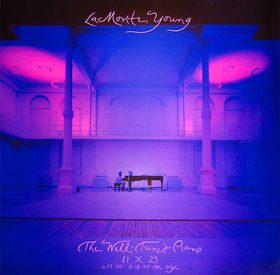
The Well-Tuned Piano (released on CD by Gramavision in 1987). As a piece, it takes immense patience to get through, not because it's difficult or boring, but simply by its length - it clocks in at a whopping 5 hours! Also, Young's approach to this most traditionally musical of instruments is some distance away from the instantly melodic works of, say
Beethoven, Nyman (latter period) or
Mahler. Young's fascination since the 60s with traditional Indian music, which focused on tones rather than notes, would culminate with the notion -developed with Conrad and Cale- of "just intonation", and
The Well-Tuned Piano is Young's attempt to apply this to the piano. It's simply a triumph, as Young's smart tunings help him circumvent the sharp attack of the piano, essentially turning it into a drone instrument. At times, he hammers away at the keys with virtuoso speed, with such shifts in tempo seeming almost random. The effect is that the quickly accumulated notes meld into one another, much as
Alvin Lucier's voice does to itself on his seminal
I Am Sitting In A Room, creating an otherworldly wall of hazy sound.
And, as with pretty much all of La Monte Young's works, the listener's relationship to the music is key to its success. How does one approach 5 straight hours of just listening? You can get up, do something else, and this in itself changes the listening process. Depending on where you are in relation to the source of
The Well-Tuned Piano, the experience of it is different. Or you can allow yourself to drift into it, to remain inert and attentive, to just listen. The experience of it will therefore be different. It's the physicality of Young's music that makes it so infinitely rewarding. And by making this, and other works like
Dream House, so uncompromising, so
transgressive, he forces the listener (and this was his most radical shift from Cage, who had a more "peaceful" approach) to engage with the music on some physical level. If you do, there is a chance it will have a transporting effect. Which I guess would count as transcendence.
As stated, any exploration of the art of
Tony Conrad is tied to that of La Monte Young, but the reverse can also be said. Conrad introduced Young to the likes of Stockhausen, and it was together that they established the notions of "just intonation" (along with John Cale) that they would both take to unparalleled heights.
Tony Conrad is one of the most interesting figures of the American avant-garde, perhaps precisely because he is so elusive. His history is a "minor" one, as Branden W. Joseph puts it in
Beyond the Dream Syndicate, though this is in no way a negative thing (read the book - it's too long to explain here)
. Julian Cope has described him as "hardcore", and whilst he comes across as a pleasant, friendly chap in interviews, Conrad's single-minded commitment to the muse of extreme sonic immobility surpasses even La Monte Young's. On the wonderful
Outside the Dream Syndicate album he recorded with German band
Faust in 1972, Conrad's violin is a phantom-like presence, hanging statically over the monolithic grooves of Faust like an ectoplasmic eagle, its constant drone being nearly terrifying in its remorseless refusal to conform to classic notions of melody or harmony.
Outside the Dream Syndicate is one of my all-time favourite drone/rock records, and they would take it to even more unrelenting levels some twenty years later when they performed "On the Side of Man and Womankind" for about an hour live in London's Queen Elisabeth Hall. But that's another story, of course...
Regrettably, much of Conrad's collaborations with Young, notably as part of The Dream Syndicate, have been kept under lock and key by Young, the source of a rather unfortunate dispute between the two men. But if you can track down a copy of
The Theatre of Eternal Music vol.1: Day of Niagara, possibly the sole existing document of the MacLise/Zazeela/Cale/Young/Conrad line-up, you will be able to testify to the supremely focused music the group played, suffused with rock'n'roll attitude but also a singular awareness of the avant-garde. Were it not for the subsequent releases of John Cale's
New York in the 1960's compilation (Table of the Elements, 2004) and Conrad's monstrous 4-disc set
Early Minimalism, Vol.1 (Table of the Elements, 1997), we might only have hearsay to base our appreciation of what they (and specifically Conrad) were achieving in the mid-60s.
Early Minimalism is easily as visionary and unrelenting as
The Well-Tuned Piano, if not more so. For, where there remains a spirit of musical expertise in La Monte Young's piece, Tony Conrad displays a concerted desire to go beyond all common notions of musicality. All 4 pieces feature his strident, distorted violin and, as on
Outside the Dream Syndicate, his deconstruction, nay,
destruction, of everything music had theorised the violin should be makes for an almost alarming first listen. There is a violence and obtuseness in the way the bow see-saws across the strings, only marginally made easier when other violins chime in, as they do four minutes in to the second piece, "April 1965". Again, the listener is shaken in his or her approach to the music, the durations (the album totals nearly four hours) and embracing of sustained tones and even atonality immediately call for a reflection on how we, as listeners, are to engage with what we're hearing.
In
Beyond the Dream Syndicate, Branden W. Joseph opposes the political stance of minimalism, notably that of Robert Morris, with the Utopian vision of Cage. Minimalism, by returning to a Dada-era organisation of power structures, was very different from Cage's almost anarchic, but slightly "hippy" (for lack of a better word) theory of art existing without such conflict between the various players of the artistic and political world. Emerging in the sixties, minimalism was ultimately tainted by the strident political and social context, from the Vietnam war to the Paris riots, establishing a dialectical relationship between artist and audience, and even artist, audience and "establishment" (be it the art one, or something greater). In this context, the screaming, atonal screes of Conrad's violin make perfect ideological, as well as artistic, sense.
Again, the ultimate reaction can be to turn
Early Minimalism off, or move away (acts of audience interaction themselves, and possibly more likely than if listening to
The Well-Tuned Piano), or you can dissolve your very
id into the maelstrom. The sensation I have always got from listening to Conrad is that, whilst Young may hold the recordings of the Dream Syndicate in his vaults, it is Tony Conrad who has taken its essence out into the realms of contemporary and popular art (see his seminal film,
The Flicker). Could The Dream Syndicate be all around us, at all times, were we just to allow ourselves to hear things differently?
To my knowledge, any association between Conrad and Young, and French composer and drone master
Eliane Radigue, is minimal. And yet, her three-hour-long opus
Trilogie de la Mort (1998, XI Records) seems to be suffused with the elegiac and transcendental atmospheres that make
Early Minimalism and
The Well-Tuned Piano so singular. The major difference (apart from the technical, of course) could perhaps be described as "spiritual". As mentioned, a major influence for Young and Conrad was the meditative classical music of Northern Indian, and there are echoes of sitars and tablas in quite a number of their productions (this embracing of Indian music would have a significant influence on underground American music, even more so than post-Beatles psychedelia, with acts like
Sir Richard Bishop and
Six Organs of Admittance quite obviously displaying similar interests). Although I think it is evident that Eliane Radigue also was aware of Hindustani raga, a much bigger influence on her life was Zen Buddhism, something she discovered and embraced in the mid-seventies.
As such,
Trilogie de la Mort may just be the most accomplished musical evocation of the "Bardo Thodol" (aka The Tibetan Book of the Dead) ever recorded. Her son, Yves Arman, was killed in a car accident in 1989, and in 1991 her guru Pawo Ninpoche also died. These losses, along with her ongoing exploration of Buddhist themes, appears to have been the catalyst for this trilogy. Radigue, formerly a student of
musique concrete pioneer
Pierre Schaeffer, had long been at the vanguard of electronic exploration, and some of her early works are masterpieces of synthesizer music, using now-obsolete Buchla modular synths. Already, in the sixties and seventies, having moved to New York from Paris, she showed an affinity with the local minimalist scene, her long, gradually unfolding pieces being directly influenced by La Monte Young and Pauline Oliveros, but with a conscious desire to move away from any form of "traditional" instrumentation (no matter how experimentally-used) and focus on electronics. Indeed, apart from Oliveros, I don't think anyone has managed to create such grandiose statements of the power of slow-burning electronic drone.
Which brings us to
Trilogie de la Mort. By the late 80s, Radigue was experimenting with the titanic analogue ARP 2500 synth, and it's the warm tones of this machine that lend
Trilogie its singular atmosphere. Starting with the opening piece, "Kyema", the drone seeps into the listener's consciousness, almost as if it had always been there, an all-encompassing cocoon of sound. As with most minimal music, what is immediately remarkable is the
stasis of "Kyema". Any variations in tempo are minimal; instead, Radigue focuses on shifts in pitch and tone, creating subtle pulsations that flutter in and out of the corners of perception. The second piece, "Kailasha" features more acute pulsations, a subtle injection of tension and drama that feels like the ebb and flow of an invisible river. If you close your eyes, this is music that will envelop and surround you, the depth of the tones meaning you no longer really
hear the music so much as actually
feel it. This of course makes sense in the tantric context of Radigue's Buddhist faith, and the notions she explores of cycles of life and death herein.
Trilogie de la Mort, being more peaceful and contemplative through its incorporation of Zen Buddhism, is a step away from the more "transcendent" minimalist drone embraced by Young and Conrad. The transcendence of
The Well-Tuned Piano and
Early Minimalism comes from the way they force a rethinking of the listener's relationship to the music and its performance or recording. Radigue's music is more instantly accessible, its flow more meditative and detached. But, like the other two masterpieces, it also takes its time to unfurl, and the listening experience is defined by the duration and "immobility" of the music. At its core, however, lies a beating heart and, delicately enveloped in warm layers of sound, that heart's quest to deal with human tragedy.
Minimalism, as an artistic discipline, has, like drone in a wider sense (drone rock, folk-drone, etc), been deemed obsolete many times. But its strands are tied to the dual posts of ancient traditions and avant-garde creative and philosophical thought, meaning it continues to reinvent itself, ultimately attaining that most inevitable of statuses: timelessness (the recent output of Eleh, coupled with the rediscovered majesty of Catherine Christer Hennix's
The Electric Harpsichord are good examples of this).

Though if you needed any further proof of this, the music of those Indian masters who, as I mentioned, paved the way for much of the musical philosophies that drove La Monte Young, Marian Zazeela and Tony Conrad, is required listening. Foremost among these was
Pandit Pran Nath, whose influence has been hailed and heralded by Young and Catherine Christer Hennix (who dedictaed
The Electric Harpsichord to Nath) with superlative effusion. And even a cursory listen of his simply-titled
Ragas (1971, Shandar) immediately reinforces the importance of this mystical figure in the development, not just of many of the spiritual, religious and philosophical tenets that drove early minimalism, but of drone music as a whole, from Young and Hennix right through to the American Primitive of
Ben Chasny of Six Organs of Admittance and
John Fahey and even noise and ambient acts such as
Vomir or
William Basinski. Pran Nath's main instrument, as opposed to, say,
Ravi Shankar, is the voice, which immediately evokes Young and, mostly, his wife Marian Zazeela, whose sustained gargle traverses albums like
Dream House (Young actually played tambouras on this album, whilst we have Zazeela to thank for the austerely arresting cover art). Nath's voice is deep, held in the throat, overlaying the minimal backing of sitar and tabla with a warm blanket of ecstatic chanting. The mind immediately thinks of Tuvan throat singing or Buddhist chanting, but there is a deliberate stance from Nath not to marry his vocalisations to the music, to allow it to hang, like Conrad would do with the violin, over the mix like a ghostly presence. He is more directly spiritual, of course, than his Western disciples (except maybe Hennix and -indirectly- Radigue), but like them suspends the notions of music as entertainment on the way to nirvana. It's blissful and spiritual, but above all, it's been hearing how this album (and his many others) has echoed through the decades, refracted by modernity, divergent cultures and technology, that has been one of the great pleasures I've garnered from this belated discovery.
As I mentioned in my last post, 2010 was a great year for music, in my opinion, and my "Top 30 albums of 2010" list clearly reflected this. But one thing I hate about such lists (apart from their obvious redundancy), is that you always discover records about a month too late that should definitely have featured, even though they came out in the relevant year! Always! And such is the case of the next two albums I'm going to hail, both of which would have been top 10 shoo-ins had I heard them before I finished my list.
First up is
Waving Goodbye, by San Francisco-based artist
Sex Worker (Not Not Fun, 2010). This is the vehicle for the man behind the provocative moniker, Daniel Martin-McCormick, to use music as a way of exploring the dark and unsavoury aspects of the sex trade. And so what we have with
Waving Goodbye (a very potent and immediately evocative title) are 6 eclectic and offbeat electro-pop tracks that disturbingly evoke the shadowy world of lost souls, grimy violence and dangerous sex that so many women around the world are forced to inhabit, all in the name of satisfying the basest instincts of men. The opening track, "Tough love" perfectly sets the tone, and is also the album's standout piece, as a loping drum machine beat and snaky, melancholic synth lines set an infectious groove over which Martin-McCormick scream-sings in a distorted, agonised falsetto. It's a nightmarish vision of violent, exploitative "love" (read: sex), as his voice literally seems to rip asunder under the weight of the horror he appears to be actually witnessing, as if he's some unfortunate pop singer forced to serenade a bunch of greasy, noxious johns in a run-down brothel. More "relaxing" is the unusual and surprisingly apt cover of Corona's 90s pop standard "Rhythm of the Night", where infectiously bland grooves and banal lyrics become a world-weary paean to lost innocence. The rest of the album follows a similar Jekyll-and-Hyde formula, between deliberately tired and defeated jazzy pop and
Ono-worthy primal screaming set to bursts of fierce electronic noise. Closer "Honeymoon Babylon", with its driving, but muffled, beat, and lamenting vocals, feels like an expression of defeated hope, a sense that, maybe things could get better, but Sex Worker doesn't really believe it.
Waving Goodbye is a powerful and ferocious statement, and one that I urge all to tap into quickly. Like the women Daniel Martin-McCormick empathises with so much, this album feels like it may evaporate into the night at any time, never to be heard from again...
In January's summary of 2010,
The Wire magazine ran an interesting article by Joseph Stannard about the resurgence of "horror movie culture" in modern "alternative" music. Pointedly -and correctly- deriding the "Splatter pack" torture porn of unimaginative twerps like Eli Roth, Stannard noted that many bands, notably among the drone/horror scenes, and on the Not Not Fun roster, were returning to the sense of gritty terror and -this is key- awe that defined the second golden age of horror, i.e. the seventies. This decade gave us on the one hand, in America, dusty, grimy, faux-realistic horrors like
The Texas Chainsaw massacre, specifically in this context its found-sound and effects-laden score; and on the other, in Italy, the baroque excess of
Dario Argento and
Lucio Fulci, who sonically were defined by their association with bombastic prog rock bands like
Goblin. And it is to these sounds, the clinks and clanks of vintage American horror, or the swirling atmospheric synths of
Suspiria or
Inferno, not to mention a dashing of creepy,
Wicker Man-inspired British psych-folk, that acts as varied as
Hair Police, Demdike Stare, Ensemble Economique, Skullflower, Umberto and
Black Mountain Transmitter have turned, with arresting results.
One particular album Stannard mentioned that tickled my fancy when I read about it, was the official, self-titled debut album of Hair Police's
Mike Connelly's solo side-project,
Failing Lights (Intransitive, 2010). Connelly's comments on the American midwest/deep south border zone he hails from (he's from Kentucky, setting for
The Evil Dead, incidentally), and the far-off, isolated farmhouses he would see whilst driving down dark roads, picturing the evil that seemed to lie behind the locked doors, really for me summed up the attraction of horror cinema of the
Texas Chainsaw Massacre variety, so I was excited to hear how he had translated that eerie menace into music. Perhaps sensibly, he has eschewed the broiling roar and hysteria of Hair Police for a calmer, more elusive approach, focusing on shimmering acoustic drones, industrial clanks
in lieu of percussion and throbbing bass lines. Starting with the heavily reverbed bell chimes on "Moon of the first hunt" to set an instant tone of menace and disquiet, but refraining from all-out explosions of noise (therefore foregoing his trademark rasping vocal howl), Connelly creates a work of perfect poise and tension. On "Revealing Scene", swathes of near-silence are punctuated by windy layers of drone before staccato bursts of electronic glitch soar into earshot from the distance, dissolving back into the ether to be replaced by more frenetic noise. Each piece segues seamlessly into the next, but whatever malaise is driving this album, Connelly never lets it be properly discerned, even on the righteous, epic closing track "The Comfort Zone", which features unhinged vocal snippets (including oppressive heavy breathing) and pulsating bass synth throbs, and basically acts as an 18-minute summation of all the creepiness that went before it. The music is cinematic, but twisted, like
Toru Takemitsu's scores for
Pitfall and
Woman in the Dunes, never demonstrative, always suggestive, and it's all the more troubling for it.
Failing Lights is a remarkable achievement, again cementing Connelly's place as one of noise music's foremost sonic explorers.
Amusingly, amid all these synths and distorted violins, I really have of late rediscovered my love for that mainstay of popular music: the guitar. Of course, it never went away, and nary a week goes by where I'm not reduced to simpering tears by the sound of someone tearing their own heart-strings out via the six on their axe, be it
Neil Young, Funkadelic's Eddie Hazel or
Derek Bailey. But the guitar in all its forms has fascinated me this month, and I've found myself traveling back in time to discover some of the older, less heralded masters whose ground-breaking work has been key to how the guitar has been used in popular music over the decades. I'm of course referring to folk and blues. There are too many of these great pioneers to mention, from classic figures like
Hank Williams, Nick Drake, Robert Johnson, Elmore James to more "recent" legends like John Fahey or Bailey. Then there are the slightly forgotten figures, among my favourites of whom are
Lightnin' Hopkins, the Texas genius and the man I'll hail here:
Son House.
Eddie James "Son" House jr was born in 1902, so by the time his fame really peaked thanks to the "British Blues Boom" of the sixties, he was an old man, and one who'd already known real poverty, the coming-and-going of fame and appraisal, and, most of all, been to prison for murder. It's this tumultuous life that defines his first real debut album,
Father of Folk Blues (1965, Columbia). He delivers the 9 songs in a creaking, worn voice, something which lends added emphasis and realism to the often troubled, doom-laden lyrics of tracks like "Death letter", "Louise McGhee" and "Preachin' Blues".
Father of Folk Blues feels earthy and impossibly real, and for an imaginative European lad like me, it immediately paints a picture of the Deep South, all dusty tracks, rickety old houses and corn fields swaying in summer breezes. It also has a darker undercurrent of religious fervour, segregation and poverty. For one man to be able to translate so much using just his gravelly voice and basic, expressive guitar picking and slide, is remarkable, even if such cliches probably say more about me than Son House!
The capacity for music to evoke not just emotions, but also mental images (or memories) of landscapes and physical realities has always fascinated me, even if the images are second-hand stereotypes like the ones I get when listening to a lot of Delta blues music (see above).
Much more nebulous is
Landings (2009, Type Records - them again!), by Lancastrian musician
Richard Skelton. The North-West of England has seemed to offer a rich vein of influence for artists of the introspective type of late (Demdike Stare, in particular), its windy moors and depressed towns seemingly haunted by a multitude of beautiful ghosts. This feeling is particularly strong on
Landings, on which Skelton juxtaposes wispy field recordings taken out in the wilderness of the Pennines with achingly beautiful strains of bowed guitar which are overdubbed over each other to create a phantom orchestra. Many have highlighted the resemblance to the "Holy" compositions of Estonian composer
Arvo Part, but this music is more abstract, less "composed", therefore bringing it more in line with Tony Conrad's violin than anything orchestral by Part. What is most remarkable is that, whilst the trace elements of the field recordings are detectable throughout, this album is in all ways dominated by the ambiguous, emotionally resonant warbles of the guitar strings; yet for all that,
Landings' attachment to, and origination from, the landscape that sculpted Skelton's vision, resonates as clear as if it were a poem dedicated to said fens, moors and furrows. As such, there is a distinct feeling of the artist as lost soul (something accentuated by the knowledge that Skelton's wife Louise passed away in 2004, and that his output has since been dedicated to maintaining a "communication" with her through music and the landscape they once shared), and there is a bleakness and desolation that is inseparable from the warm drones and delicate sounds of wind and rain.
Landings is a modern masterpiece of minimalism, so I've almost come full circle here; but it's rich emotional palette easily sets it apart from just about every other drone release I can think of.
Potentially the closest musical cousin I can think of for
Landings would be
Fly, Fly My Sadness (1996, Jaro) by
And what of
Keiji Haino in all this? I hear you ask. After all, he's been my be-all and end-all muse ever since I saw him at ATP, right? Indeed, if anyone thought they could get away without a Haino reference, they're going to be sorely disappointed. I may have been listening to enough minimalism, "world" music, free jazz and drone to fill a lifetime, but in the weeks since he ripped my soul to wondrous shreds on December 6th, Haino has never been far from my ears. It's as if I can't do without him...
I was particularly fortunate to finally be able to get my mitts on a slew of highly-regarded Haino releases, from the slightly underwhelming, folky and eclectic
Affection (1992, PSF), to the bonkers and excessive hurdy-gurdy drone on
The 21st Century Hard-y-Guide-y Man (1995, PSF), via the demented and noisy blues-from-
Fushitsusha freakouts
Execration that Accept to Acknowledge (1993, Forced Exposure) and
The Book of Eternity Set Aflame (1996, Forced Exposure). All of which are, even
Affection, key documents of the wild talent of Keiji Haino.
But undoubtedly the best discovery of this already outstanding bunch was the ridiculously-titled
"C'est parfait" endoctriné tu tombes la tête la première n'essayant pas de comprendre quelque chose si tu te prépares à la décision d'accepter tout compris / Entre en toi-même cela se résoudra (2003, Turtle's Dream), hereafter referred to as
C'est Parfait! If ever anyone needed proof that there are no limits to the inspiration and willingness to experiment that drive Keiji Haino, this is the -sadly very rare- album to track down. Supposedly, this is a live recording, but if so he has obviously sampled, overdubbed or pre-recorded his voice, given the way vocal lines are layered on top of one another. And this is as good a place as any to reiterate that Haino is one of the most incredible vocalists that has ever existed. Whether he is mewling in a high-pitched fashion, sounding like an androgynous ghost trying to communicate with the living, or ripping his vocal chords asunder with guttural, rasping roars, he always pushes his voice to the extreme, and the results are overwhelming. Of course, as with the Tuvan throat singers and Pran Nath, I have no idea what he's singing about (and with a title like the one this album has, I doubt I'd really be able to make sense of the lyrics if I did!), but sometimes words are superfluous to the actual appreciation of pure, unfettered emotion laid bare. His uttering is alternately sexual and terrifying, and always instantly arresting. And the way he mixes the different vocal lines together, like so many coiling snakes, is astounding.
In addition to the vocals, the only other instrument used appears to be a drum kit, or an assortment of modern and traditional percussive instruments, but if you think this will be a mellower record than
Execration that Accept to Acknowledge or his work with Fushitsusha, simply because he is leaving the guitar and synths to one side, you'd be mistaken. So very mistaken! If anything, the percussion gives Haino even more leeway to go bonkers, and the image in my head is of the tiny, mane-haired man leaping from one set of skins to another, bashing at them like a wild man before moving on again, along the way stopping at one of several microphones to bellow, moan or shriek almost incoherently. Of course, Haino is a lot smarter and erudite than that image suggests, and this is a very intelligently constructed piece, with each instrumental break and vocal interplay carefully thought out in the grand tradition of avant-garde composition
and free improv. But for all that,
C'est Parfait remains defined by the manic energy and unrelenting sonic devastation Haino unleashes. It's one of the most wonderfully scary albums I own.
Re-reading all of the above, I'm staggered at how long this has got. And yet, I have only evoked the tip of the cultural iceberg I've been trying to scale this month. I should mention the lovely live show put on by
David Hoyle at The Royal Vauxhall Tavern on January 27th as part of his
Lives residency. I was largely unfamiliar with the work of the man behind
The Divine David, and his combination of performance art, acerbically witty comedy and post-drag dressing up was a tasty treat on a Thursday night. It was intellectually challenging, but above all, it was fun, which should always be highlighted given the po-faced nature of so many art shows. I even ended up on stage at one point, and had a portrait done of my penis in the toilets! Weird times. Special mention must go to former 80s Goth icon
Rosie Lugosi, whose poetry readings and stand-up centred on her recent battle with cancer. Witty, self-deprecating and defiant against the disease, she encapsulated the word "inspiring". All in all, it was a lovely demonstration that "gay culture" does not have be limited to gormless twinks shrieking at vapid reality stars in Heaven.
And in music, I could talk of my adventures into "American Primitive", the neo-folk of
Sir Richard Bishop, Six Organs of Admittance and
John Fahey. Albums like
While My Guitar Violently Bleeds, Dark Noontide and
Fare Forward Voyagers (Soldier's Choice) have never been far from my ears this month, nor have the dark European equivalents of
Current 93's
The Inmost Light, the wonderful reissue of
Sand's dark-folk/Krautrock masterpiece
Golem and
Tenhi's
Maaaet. And my absorption of the blues was not limited to Son House, as I mentioned. From an all-encompassing
Robert Johnson compilation to 2009's remarkable modern blues classic
New Ways to Pay Old Debts by former
Harry Pussy guitarist
Bill Orcutt, I've been well and truly breathing in the dusty vibes of deep, dark Devil's music. Speaking of which, also discovered this month was the creepy compilation
Okkulte Stimmen: Mediale Musik - Recordings of Unseen Intelligences 1905-2007, which features 30+ "real" recordings of ghosts, exorcisms and other odd and occult curiosities. Not for the faint-hearted!
And of course, I've not left the worlds of noise and metal far behind, still relishing in the sonic assaults of acts like
The Cherry Point, Werewolf Jerusalem, Jesu, Gnaw Their Tongues,
Demons and
Hair Police. Free jazz as well, with lovely discoveries in the form of
John and Alice Coltrane's 1968 collaboration
Cosmic Music, and the work of
Rahsaan Roland Kirk. And then there's been all that avant-garde music I barely touched upon! Jesus...
Well, that's what February will be for, I guess. So, until next month's eclectic mix of spiritual folk, raw blues, fierce noise and sonic experimentation, not to mention films by
Lars Von Trier, Lucio Fulci, Jack Smith and
Derek Jarman, it's adios, and keep those turntables spinning, those iPods whirring and those concert venues bouncing!
Peace. JPhimister
-February 2011