A truly vintage month, was June 2010, one in which I discovered a wealth of bands I'd never heard before, and who have all turned out to be amazing! So much so, that Osborne's poor-hitting budget and the World Cup have registered only faintly on my radar. Believe, jangling guitars, noisy synths and overloaded drums make a much better soundtrack to Greece v Nigeria than Guy Mowbray (or whoever)'s mindless patter! So, without further ado, etc...
"Noise" is the key word for June 2010, as I delved head-first into some of the most ear-shattering music I'd heard in a while (maybe Lou Reed's concert inspired me), at least since those heady days when I was unearthing a new Skullflower album per day!
Noise is a peculiar genre, and I still struggle with the kind of harsh, computer-generated noise espoused by the likes of Merzbow (though I love Venereology). The very "raison d'etre" of noise, as a genre, is to push the boundaries of the listener's tolerance, his or her ability to stand the sheer volume, abrasive high notes and atonality on display. With the high frequencies available via computers and electronics, this becomes even harder, as anyone who has discovered Whitehouse will testify. But if you open your mind (and ears), and let the noise wash over you (eyes closed helps, I find), its power is undeniable, even at its most extreme, and this month's exposure to new-fangled noise encouraged me to put aside my -slight- aversion to the harsher side of noise and resurrect a couple of my particularly loud, bad and aggressive noise CDs. Which is where I'll start!

 Also released in 2006 was Chimärendämmerung, by one of Skullflower genius Matt Bower's side-projects, Hototogisu (De Stijl), a collaboration with Marcia Bassett, of Double Leopards and Zaimph "fame". Which is also a good chance to laud Bower's album from the same year as Skullflower, Tribulation (Mordam Records), as the two are almost peas in a pod in terms of scope, ambition and -crucially- volume.
After a long hiatus in which he mainly operated in another outfit, Sunroof!, Bower returned to Skullflower in 2003 with Exquisite Fucking Boredom, and has pretty much operated as a one-man band since then, eschewing the drums- and bass- doom metal of albums like IIIrd Gatekeeper and Carved Into Roses in favour of walls of saturated guitar noise and digital effects, with a huge number of successive albums coming out since the revival of the "band". Of them all, Tribulation is probably the harshest, most violent and most uncompromising, its nine tracks being the kind of mangled, unrelenting guitar noise that will make most people bleed from the ears and lurch full-speed for the "off" switch of their stereos. Tribulation is cut from the same razor-sharp guitar cloth as Lou Reed's controversial Metal Machine Music, with Bower's stubborn refusal to deviate from his relentless screes of feedback and harsh metal noise. The difference with Reed's masterpiece is Bower's new-found interest in computer-generated harshness and subdued metallic percussion to complement his axe soloing It takes immense patience to delve into Tribulation, but few albums go about their task of unsettling and assaulting their listeners with such impressive single-minded-ness.
 One of them, of course, is Chimärendämmerung. It is in many ways the perhaps-not-quite-so-evil twin of Tribulation. There is still more of Bower's trademark harsh, harsh, super-saturated guitar feedback, but he has cut back the power electronics he now favours with Skullflower, allowing for something that is more spacious, less claustrophobic. Orange Canyon Mind and Tribulation have echoes of Prurient's sturm-und-drang, whilst more recent Skullflower albums like Strange Keys to Untune God's Firmament are more deeply anchored in Sunn O)))-influenced doom metal, but with Hototogisu the approach is more "measured", for lack of a better word. The volume is still unsettling, with high-pitched squeals and whistles giving one's ears the Wolf-Eyes treatment, but there is also a sense of space, surely provided by Bassett and her background in gloomy folk-drone in Double Leopards. At times, Chimärendämmerung touches the psychedelic, its vastness becoming all-encompassing like "Interstellar Overdrive"-era Pink Floyd, only a Pink Floyd in which the drums, guitar solos and Syd Barrett's voice have all been swallowed by his guitar feedback and Richard Wright's overloaded organ, the whole lot then recorded on volume 11. Ok, so that's not a very helpful comparison (maybe the Velvet Underground playing "Sister Ray" would be a more apt description), but the feeling you get is that motorik psychedelia has been pushed to its outer-most limit and melted into noisy drone. Weird but true!
Noise is one of the more geographically-delimited genres of modern music, efficiently sub-categorised by country or even areas of a country. Therefore, we had the London noise scene, that grew out of industrial music and gave us Whitehouse, early Current 93 and Nurse With Wound and Skullflower. There's Japanoise, of course. And in America, differentiation is made between the Noise that hails from California, the Midwest, Providence and New York. Confusing, but it actually makes digging through it all a bit easier, as so many bands from each "noise region" are inter-connected, related or operate in similar styles.
Brooklyn has become the new jewel in the crown of noise scenes, getting many column inches, from Pitchfork to The Wire to Dusted. And it's deserved praise, as the scene in New York's "second borough" is simply effervescent, and in fact extends well beyond noise, giving us the trippy electronic of indy faves Animal Collective, the warped electro-drone of Excepter, and Gang Gang Dance's pounding avant-disco.
One of them, of course, is Chimärendämmerung. It is in many ways the perhaps-not-quite-so-evil twin of Tribulation. There is still more of Bower's trademark harsh, harsh, super-saturated guitar feedback, but he has cut back the power electronics he now favours with Skullflower, allowing for something that is more spacious, less claustrophobic. Orange Canyon Mind and Tribulation have echoes of Prurient's sturm-und-drang, whilst more recent Skullflower albums like Strange Keys to Untune God's Firmament are more deeply anchored in Sunn O)))-influenced doom metal, but with Hototogisu the approach is more "measured", for lack of a better word. The volume is still unsettling, with high-pitched squeals and whistles giving one's ears the Wolf-Eyes treatment, but there is also a sense of space, surely provided by Bassett and her background in gloomy folk-drone in Double Leopards. At times, Chimärendämmerung touches the psychedelic, its vastness becoming all-encompassing like "Interstellar Overdrive"-era Pink Floyd, only a Pink Floyd in which the drums, guitar solos and Syd Barrett's voice have all been swallowed by his guitar feedback and Richard Wright's overloaded organ, the whole lot then recorded on volume 11. Ok, so that's not a very helpful comparison (maybe the Velvet Underground playing "Sister Ray" would be a more apt description), but the feeling you get is that motorik psychedelia has been pushed to its outer-most limit and melted into noisy drone. Weird but true!
Noise is one of the more geographically-delimited genres of modern music, efficiently sub-categorised by country or even areas of a country. Therefore, we had the London noise scene, that grew out of industrial music and gave us Whitehouse, early Current 93 and Nurse With Wound and Skullflower. There's Japanoise, of course. And in America, differentiation is made between the Noise that hails from California, the Midwest, Providence and New York. Confusing, but it actually makes digging through it all a bit easier, as so many bands from each "noise region" are inter-connected, related or operate in similar styles.
Brooklyn has become the new jewel in the crown of noise scenes, getting many column inches, from Pitchfork to The Wire to Dusted. And it's deserved praise, as the scene in New York's "second borough" is simply effervescent, and in fact extends well beyond noise, giving us the trippy electronic of indy faves Animal Collective, the warped electro-drone of Excepter, and Gang Gang Dance's pounding avant-disco.


 Also operating somewhere between the darker recesses of the Underground and the lighter aspects of audience-friendly (ish) sounds are California's Yellow Swans. I should say "were", sadly, as the duo no longer exist, with Going Places (2010, Type Records) being their swansong. But what a way to say adieu! Going Places is so far one of my favourite albums of what is shaping up to be quite a year for modern pop (more of that later, but I have to say that 2010 looks liable to eclipse 2009, which was already a stonker!).
In some ways, Going Places is more traditionally "noisy" than the Brooklyn bands above. Certainly, there are no jazzy drum patterns, dreamy voices and pop flourishes here. Yellow Swans create vast walls of sound using electronics and guitars, no drums and nothing remotely relating to familiar strains of popular music. But, where Wolf Eyes or Prurient or Merzbow prefer to ferociously brutalise their listeners, the sound here is loud, but occasionally warm, or at least not always that harsh, envelopping the listener in a blanket of buzzing drone and creating the kind of haze that suits the cover imagery perfectly, and would not be out of place on a Leyland Kirby or Oneohtrix Point Never album, albeit with stomping electronic percussion added for good measure. Going Places (love the ironic title!) therefore acts as an elegy to the band's career as it ends. It's a moving and fitting farewell. And still a flippin' loud one!
Also operating somewhere between the darker recesses of the Underground and the lighter aspects of audience-friendly (ish) sounds are California's Yellow Swans. I should say "were", sadly, as the duo no longer exist, with Going Places (2010, Type Records) being their swansong. But what a way to say adieu! Going Places is so far one of my favourite albums of what is shaping up to be quite a year for modern pop (more of that later, but I have to say that 2010 looks liable to eclipse 2009, which was already a stonker!).
In some ways, Going Places is more traditionally "noisy" than the Brooklyn bands above. Certainly, there are no jazzy drum patterns, dreamy voices and pop flourishes here. Yellow Swans create vast walls of sound using electronics and guitars, no drums and nothing remotely relating to familiar strains of popular music. But, where Wolf Eyes or Prurient or Merzbow prefer to ferociously brutalise their listeners, the sound here is loud, but occasionally warm, or at least not always that harsh, envelopping the listener in a blanket of buzzing drone and creating the kind of haze that suits the cover imagery perfectly, and would not be out of place on a Leyland Kirby or Oneohtrix Point Never album, albeit with stomping electronic percussion added for good measure. Going Places (love the ironic title!) therefore acts as an elegy to the band's career as it ends. It's a moving and fitting farewell. And still a flippin' loud one!
As I wrote before, 2010 is turning out to be an awesome year. I've already saluted Indignant Senility, Eleh and Yellow Swans, but, away from such oddball drone epics we have also had some pretty amazing albums in notably different genres.


So yes, 2010 is shaping up to be a stonker. I'm also still delving into a back-catalogue of noise, drone and hypnogogic records, so July on my iPod!! is liable to be as long as June. Happy Days!
The election has now been and gone, and the hung parliament led to a coalition of earnest but dull people in charge. We've already had the first scandal, which was dull, and the first grumblings of discontent from Tory back-benchers, which amounted to sweet fanny adams. Indeed, the world goes on: comedy (Lembit Opik and John Prescott incomprehendingly exposing themselves to Hislop's cruelty by appearing on Have I Got News For You), tragedy and boredom. Same shit. And Richard Littlejohn continues to show how much of a revolting piece of ambulant dung he is by verbally slagging off murder victims rather than the perpetrator. Charming.
As always, thank fuck for music and art. In March and April, I actually caught two fabulous exhibitions that somewhat melded the two, with Florian Hecker using projected sounds to amazing effect in his solo show at Bethnal Green's hidden treasure, The Chisenhale Gallery. Powerful speakers were arrayed in such ways that the sounds they produced -digital noise, found sounds, disembodied voices- bounced around and over listeners (spectators?) creating the sonic equivalent of avant-garde sculpture. Meanwhile, at The White Cube near Green Park, Cerith Wyn Evans' Everyone's gone to the movies, now we're alone at last...' was a masterful sculpture show, notably his "S=U=P=E=R=S=T=R=U=C=T=U=R=E ('Trace me back to some loud, shallow, chill, underlying motive’s overspill…')" where electrical towers unleashed searing white heat on the room. If these shows ever come to a gallery near you, I heartily recommend them.
A remarkable lack of hauntology or hypnangogy this month, or even dubstep, meaning the below selection may just be my broadest yet. And, with one exception, I am going to stick to albums from 2009 and 2010. Wild.
Starting in Africa, 2007 saw the release of one of the best (and least-heralded) releases from that continent in quite some time, Group Inerane's Guitars From Agadez (Sublime Frequencies). It's a great entry point for anyone curious about the music of Northern Niger's berber people, and I'll admit to having been a complete neophyte until discovering this marvellous release.
It's often described as a form of desert blues, although the connections to the music of Muddy Waters or even Ali Farka Toure, are tenuous at best. Rather, Inerane play insistent (even "motorik") percussion that serves as a platform for snaking, rough guitar soloing from the band's virtuoso leader Bibi Ahmed and the surreal chanted vocals and ululating screams of the female singers. It's music born from the Berber tribes' suffering under successive Nigerien governments, the guitars becoming metaphors for the slung rifles of desert combatants. I haven't heard an album this good come out of Africa since I first discovered Toumani Diabate's New Ancient Strings. I kid ye not!

And so to 2010, which had already kicked off in some style with the CD release of Indignant Senility's Plays Wagner and Eleh's Location Momentum, and looks set to get better and better with new albums by Rene Hell, Ital Tek, Sun Araw, Oneohtrix Point Never and Flying Lotus all to come.
Julian Cope alerted me to the motley genius of Excepter, former noiseniks who have been releasing off-kilter psychedelic drone rock since 2003, under the guidance of former No Neck Blues Band alumnus John Fell Ryan.
Presidence (2010, Paw Tracks) is their most ambitious album to date, two CDs-worth of delirious sound sculpted from live improvs into vibrant, experimental sound collages. It's nearly all synths, bar some rudimentary electro percussion, a cacophony of blurbs, bleeps, whoops and buzzes supplimented by warbly, incoherent vocal snippets and thumping, monolithic drum machine beats. It's one of the weirdest albums I've heard in a while, and a trial to sit all the way through in one go (two tracks, "OP" and "Presidence", last around 30 minutes!), but few are likely to be this rewarding.

 Brian Eno's Music For Airports (1978) was the first in his legendary Ambient series, and the record that to this day probably best encapsulates the philosophy and essence of the genre. So, when I read that some electro upstarts were preparing to release a terse retort to Eno's masterpiece, I was pretty miffed.
But also a bit curious. And luckily, The Black Dog's Music For Real Airports (2010, Soma Records) is a stunning album, even (especially?) if you step back from the context of it being a riposte to Music For Airports. But, in essence, The Black Dog's Ken Downie objected somewhat to the idealised atmosphere of Eno's work, finding it lacking in depth in its elegiac tone, and dishonest for not highlighting that airports are places where social alienation, sleep deprivation and endless queueing are the norm, as well as being massive polluters. Fair enough, but Eno's work was much more a formal than metaphysical or philosophical effort, concentrating on creating an ambience that was as intagible as it was affecting, an aim that I think he succeeded in fulfilling. The notion of the airport as a physical and socio-political establishment was secondary. It was music to play in an airport, not to evoke the experience of being in one.
Dispensing with any polemic means you can concentrate on Music For Real Airports on a purely aesthetic level, and here it is nothing short of a triumph. It's clearly and deliberately conceptual, with song titles like "Terminal EMA", "Wait Behind This Line" and "Passport Control", and the opening track, "M1", with its sounds of a car pulling into East Midlands Airport's car park and footsteps entering the terminal greeted by a disembodied recorded voice reminding us that smoking is prohibited, sets a scene that is tangible and real. These real life reference points crop up throughout the album, making the listener's response to the music all the more visceral.
In the main, like Eno's album, the music here is sustained, lengthy ambient electronica, with drifting synth lines and subdued melodies. But the tone is darker, more haunted, with a scope that is voluntarily cinematic, with a sort of stripped-down post-Vangelis spaciness inhabiting the soundscapes. Again, true to the concept, The Black Dog do not hold back on being illustrative of the airport experience's negative aspect and nowhere is this more evident than on "DISinformation desk", where the emphasis of the prefix is reflected in pulsating rhythm effects that build and build, heightening the sense of unease and irritation. "Wait Behind This Line" is similarly edgy, with moody sampled strings and more throbbing percussion.
Like being stuck in an airport whilst in transit, Music For Real Airports is repetitive, cold and subdued. It's even tiring. And few albums these days are this conceptual and attentive to the thought process that went into their creation. Definitely the ALBUM OF THE MONTH.
Brian Eno's Music For Airports (1978) was the first in his legendary Ambient series, and the record that to this day probably best encapsulates the philosophy and essence of the genre. So, when I read that some electro upstarts were preparing to release a terse retort to Eno's masterpiece, I was pretty miffed.
But also a bit curious. And luckily, The Black Dog's Music For Real Airports (2010, Soma Records) is a stunning album, even (especially?) if you step back from the context of it being a riposte to Music For Airports. But, in essence, The Black Dog's Ken Downie objected somewhat to the idealised atmosphere of Eno's work, finding it lacking in depth in its elegiac tone, and dishonest for not highlighting that airports are places where social alienation, sleep deprivation and endless queueing are the norm, as well as being massive polluters. Fair enough, but Eno's work was much more a formal than metaphysical or philosophical effort, concentrating on creating an ambience that was as intagible as it was affecting, an aim that I think he succeeded in fulfilling. The notion of the airport as a physical and socio-political establishment was secondary. It was music to play in an airport, not to evoke the experience of being in one.
Dispensing with any polemic means you can concentrate on Music For Real Airports on a purely aesthetic level, and here it is nothing short of a triumph. It's clearly and deliberately conceptual, with song titles like "Terminal EMA", "Wait Behind This Line" and "Passport Control", and the opening track, "M1", with its sounds of a car pulling into East Midlands Airport's car park and footsteps entering the terminal greeted by a disembodied recorded voice reminding us that smoking is prohibited, sets a scene that is tangible and real. These real life reference points crop up throughout the album, making the listener's response to the music all the more visceral.
In the main, like Eno's album, the music here is sustained, lengthy ambient electronica, with drifting synth lines and subdued melodies. But the tone is darker, more haunted, with a scope that is voluntarily cinematic, with a sort of stripped-down post-Vangelis spaciness inhabiting the soundscapes. Again, true to the concept, The Black Dog do not hold back on being illustrative of the airport experience's negative aspect and nowhere is this more evident than on "DISinformation desk", where the emphasis of the prefix is reflected in pulsating rhythm effects that build and build, heightening the sense of unease and irritation. "Wait Behind This Line" is similarly edgy, with moody sampled strings and more throbbing percussion.
Like being stuck in an airport whilst in transit, Music For Real Airports is repetitive, cold and subdued. It's even tiring. And few albums these days are this conceptual and attentive to the thought process that went into their creation. Definitely the ALBUM OF THE MONTH.


To think I almost didn't go! When my mates Tim and Mark floated the idea, the line-up wasn't yet as fleshed-out as it would prove to be, and I was certainly less adamant I had to go than for the 10-year Anniversary edition last December (SUNN O))), Bardo Pond and OM, for chrissakes), or indeed than I am for the upcoming Godspeed You! Black Emperor edition this year. But this ATP, curated by Matt Groening (who is, a soft spot for irritating whining female singer-songwriters aside, a man of exquisite musical taste), exceeded all expectations. The weather was mainly shite, and ridiculous levels of whisky and beer consumption on the Sunday made most of that day a write-off, but my ears got a phenomenal pleasure assault and fucking hell - I GOT JAMES MOTHERFUCKIN' CHANCE'S MOTHERFUCKIN' AUTOGRAPH!!! Ahem, sorry about that, but I needed to get it off my chest.
As per the last time, Tim, Mark and I, accompanied by our wonderful "token female with a mooncup" Harri, rocked up on the afternoon of the 7th, our car loaded with booze and cheap food, ready to overindulge, it turned out, in a weekend of jovial debauchery. The excellent planning meant that hardly any bands overlapped, and we luckily had a nice hour to settle in before the first set I desperately wanted to see, Birmingham haunt-pop duo Broadcast, who had produced one of the more beguiling albums of 2009 with their collaboration with The Focus Group, Investigate Witch Cults of the Radio Age (Warp Records). My friends left halfway in, one later describing the pair as "shit". Certainly, the first 30 minutes were a challenge, with the influence of The Focus Group evident as Broadcast attempted a live collage piece that was weird, off-beat and, a shame given Trish Keenan's lovely voice, mostly vocals-free. It didn't always work, but I for one admired the attempt and felt the roughness of it was more due to the sound problems that would hamper a number of acts. Besides which, almost immediately after my trio of buddies departed, the band switched to standard Broadcast fair, with pulsating dance beats and shimmering psychedelic synth ambience acting as the perfect platform to launch Keenan's delightful, reverb-drenched voice at the audience. Highlighting the duo's place at the forefront of the new "hauntology" scene, their set was wistful and mysterious, as weird images were projected onto a canvas over their heads. In fact, it was probably the only one that suffered from a planning perspective as, like Bardo Pond in December, they would have been much better suited to an early morning appearance when every one would have been drunk and stoned enough to really get into their oddball sound. A shame.
I had to grab a bite then, so skipped Built to Spill, whose sound left me rather indifferent from what I heard in passing, but I was back at the Centre Stage for Cold Cave, whom I only knew from The Wire's end-of-the-year top 50 (at 49, I think). They were a pleasant surprise, performing atypically in near-total obscurity and featuring a sound halfway between the driving electro-pop of early Soft Cell or Human League, but with a suitably mournful/stroppy-sounding lead singer, some heavy post-industrial beats, and a general air of sexualised modernist decay. Plus, they have Prurient on synths!
Iggy and The Stooges were next, on the Pavillion stage, but I'd seen them a few days beforehand, and I really don't like the cavernous, impersonal feel of that setting, so after a couple of songs, where the band played almost the same set as at The Apollo and Iggy confirmed he still has enough energy for 12 men despite playing to back-to-back gigs less than a week earlier, I headed back to the chalet for a nap and a beer, returning to the Centre Stage in time for Toumani Diabate and his band, who were one of the best acts of the weekend. Far from the delicate, pastoral sound of his New Ancient Strings magnum opus, this saw the great man taking on groovy African funk, with scattered polyrhythmic percussion, electric guitar and two energetic singers. The unshackled enthusiasm onstage quickly filtered through to the crowd and soon it had become a foot-pounding, hip-shaking mass of humanity, for one of the most joyful scenes I have ever witnessed at a concert. Watching my buddy Tim in particular lose himself to the groove in a completely unfettered way was something I won't forget for a while. At half-eleven I also caught half a set by Japanese pop-punk band Shonen Knife, whose simplistic guitar riffage and cheesy shouted vocals were charmingly (if rather insubstantially) offset by their uber-sexy demeanor and amusing in-between-song banter ("Do you like sushi?").


Such a mad couple of months, with gigs, new albums, work and flat-hunting all combining to mean I have to combine them both this time for an iPod extravaganza! Which means you all (sigh) get a bit longer to absorb my recent post on memory music. Lucky you!


 Equally evocative -oddly- of fog-laden forests, grim trailer parks and crumbling colonial houses in America's hinterland is Indignant Senility's Plays Wagner (Type Records, 2010), a monolithic slab of scratchy drone that owes a huge debt to the work of The Caretaker, whilst still managing to sound rather unique. As the title suggests, Indignant Senility's Pat Maherr has taken the bombastic "classical" music of Richard Wagner and "played" with it. The result couldn't be much further removed from Wagner. Using old vinyl recordings of the German's music, and then twisting, turning, distorting and pummeling it beyond recognition, Maherr has created a massive gothic soundscape, where snippets of the old master's strings or orchestras seep into the mass of electronic drone like shafts of light, or ghosts of long-dead German aristocrats, heroes and princes trying to muscle their way back into reality. It's an exhausting listen, at 78 minutes in length, but a truly troubling and haunting one.


Phew! What a slab! I'll avoid mentioning the dismal election result here in the UK which sees us foisted with the most unpopular and uninspiring government in decades, simply because it's just too dire for words. Proof if ever that voting in this country means fuck all. Still, it was worth it just to see Lembit Opik and Adam Boulton's meltdowns. Almost...
It's been a ruddy good couple of months for them, and things are set to get better, with ATP, Boris, Teeth of the Sea and Ben Frost still to come!
note: the pictures below are not mine, but are, I believe from the gigs in question
Skream and Benga - Fabric, London; March 19 2010
Boxcutter, Kuedo and others - Corsica Studios, London; April 9 2010
Two club sets just a couple of weeks apart were the perfect introduction for me to the dubstep live experience. I'm glad I was prepared for how loud it would be, especially at Fabric where the pounding drum patterns and sub-sub-bass hit crushing volume levels.
Skream and Benga are the genre's two young superstars, a deserved reputation as they are also two of the most talented producers out there. I do have my reservations about the whole experience, though. Fabric is a pretty vile place, a club "superstore", soulless and brimming with tourists. The average age of the audience must have been 20, making me feel somewhat out of place. To top things off, Skream and Benga didn't come on until 3am, meaning I had to drink my way through the boredom of a number of other, less enthralling performers.
I would like to say it was worth it. Certainly, they are a talented duo, and I loved that they decided to perform side-by-side, taking turns to release their respective riffs and tunes, and supporting each other with much arm-waving to the crowd when not at the decks. But 6 hours is a long time to wait with only inaudible chats with friends and lots of beer as company. Plus, their set was partly spoiled by the irritating presence of a couple of MCs whose only vocal interventions seemed to be to repeat the words "Skream and Bengaaaaaaaaaaaaa!!!" ad infinitum. A shame, as both Croydon lads are excellent tunesmiths and when they were flying, the crowd's reaction was unlike any I'd seen in a club, even Berlin's cathedral-like Berghain. Benga was the hero for me, his pounding rhythm tracks setting a monstrous groove under industrial synth lines. But, by the time the set ended at 5 I was weary, and the MCs had driven me to the back of the room to lean against a pillar grumbling into my umpteenth bottle of Budweiser. Still, the experience of seeing hundreds of 20-somethings bouncing up and down to the thudding bass lines of two of of dubsteps most exciting stars was memorable, and proof perhaps that the genre has finally entered the mainstream. Where it goes from here remains a mystery...
The Corsica Studios are an altogether more intimate venue, with two small-ish rooms linked by tunnel-like corridors running under the dingy archways of Elephant & Castle in gloomy South London. A perfect setting for a dubstep evening that was cheap, good-natured and blessed with some amazing music.
I don't remember all the artists I saw, but even those I was unfamiliar with were able to get the young, arty crowd bouncing. I had come to see Boxcutter, whose excellent Oneiric album (Planet Mu, 2006) has been a recent fave of mine, and Kuedo, aka Jamie Vex'd, one half of the sadly now-defunct Vex'd, whose Degenerate (Planet Mu, 2005) remains one of the true must-have dubstep albums.
Boxcutter's style has evolved notably since Oneiric's IDM-inflected indo-dub, moving towards more house-y synth patterns and graceful pop. For this set he added a live electric bass to his programmed patterns and whilst it didn't always work, lurching into wanky noodling occasion, there were times when it hit a spacey electro groove reminiscent of The Field.
But if Boxcutter was good, Kuedo was amazing, cranking up the volume and the thumping beats and mixing the best of Vex'd's post-industrial dub with the retro synthetic approach that has made Joker and Joy Orbison the new darlings of the UK club scene. Like them, Kuedo's synth riffs evoke a cross-section of 80s and 90s pop culture, from cheesy movies to old skool hip-hop and garage to video game soundtracks. But Kuedo's beats are that much more massive and thumping, whilst heavy basses churn away underneath the mix. Industrial dance at its best, Kuedo is an artist to watch, especially as his new EP Dream Sequence (Planet Mu, 2010) is also excellent.
Lou Reed's Metal Machine Trio - Royal Festival Hall, London, April 19 2010
The Metal Machine Trio's album The Creation of the Universe (Sister Ray Records) was one of the best surprises of 2008 or 2009. Which is not a slight on mister Reed (although his post-Songs for Drella output has been patchy at best), but rather a testament to how exciting, raw and adventurous the new album was. The Creation of the Universe saw Reed crowbar-ing free improv into his own curmudgeonly musical philosophy, delivering something that was unpredictable but concise, noisy but efficient. An essential album, but one that sat uneasily in any category, be it improv, rock or noise.
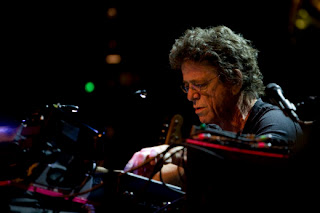
Instead, it seems most of the prats in the auditorium hadn't read the script, hadn't wondered what the "Metal Machine Trio" could possible imply, and had turned up expecting a run-through of hits, from "Perfect Day" to, um, "Walk on the Wild Side". As far as I'm concerned, these middle-aged dipshits got what they deserved. A good 30 minutes of feedback greeted everyone as we filtered our way into the glorious main hall, and already some of the grey-haired biddies around me looked troubled. When their enthusiastic applause at Reed's eventual appearance was drowned out by a wall of guitar feedback, electronic noise and strident sax, most decided, after a few minutes of very Britishly polite consideration, to head en masse for the exit.
For those of us who stayed it was a true monument to free exploration of sound. The error here would be to expect Reed to play the improv game by the book. No, Lou Reed is Lou Reed, and even when improvising, he controls everything, with his usual sour temper. As such, you could see him bossing electro wizard Sarth Calhoun as to how to pound out his electronic drones, whilst sax genius Ulrich Krieger always deferred to the New Yorker, even when in full squalling flow. And why not? It's Lou Reed, for chrissakes! It's been a while since we were privileged to hear the great man's singular take on feedback virtuosity, and I for one one was enthralled, as rumbling drones made way for high-pitched saturation and then back again. At the end, the aging (he's 68, for fuck's sake) rocker waddled over to the giant gong behind him and gave it a resounding bash that woke up the old man beside me and brought this tumultuous, rapturous set to a close. All I can say is, fuck those dozy cunts that walked out (and I've never seen so many people head for the doors at a gig), and I am glad I got to see a grumpy old fart do what he still does better than most - make a fucking racket!
Iggy and the Stooges + Suicide - Hammersmith Apollo, London, May 3 2010
I think I was probably the only person in the audience who preferred the opening act to the main guys. As part of the interesting "Don't Look Back" series (organised, I believe, by ATP Recordings), Iggy & The Stooges were playing the entirety of their seminal Raw Power album, whilst Suicide would assault us with their complete debut. An evening of pure sonic bliss would surely present itself.
Ah expectations. I'm pretty sure they are the mother of all fuck ups. Which is not to say the gigs weren't great. They were. But maybe after dreaming of this moment for years, those damned expectations were bound to put the cat among the pigeons.
Suicide have the advantage of having a reputation built on a talent for making music difficult for their audiences. When they first appeared in London supporting The Clash, someone threw an ax at them, after all! As such, I was prepared for them to be challenging. I was not expecting it to be so loud, though! It must be kept in mind that Alan Vega and Martin Rev, the pioneering duo that makes up Suicide, are old. Vega is 71! But Rev's thundering drum machine patterns and warped synth noise roared out of the speakers at ear-shattering volume from the off, as they smashed "Ghost Rider", the album's amazing opener into the ground. Vega looked his age in a ludicrous yellow beanie, no longer able to jerk around stage whilst hitting himself in the face with the mic and starting fights with the audience. But he has traded in such antics for the mother of all "fuck you" attitudes, slouching around the stage and growl-shouting his lyrics as his voice is twisted and mauled by ridiculous amounts of reverb. At one pointm in true bastard rock curmudgeon style, he lit a cigarette and smoked it onstage, before apparently getting signalled that he would be in some shit if he didn't stub it out. Not really punk rock, but a nice little bit of grizzled, ageing defiance.
But Rev was surely the star. He barely looked at the audience as he hid his face under weird fluorescent wrap-around shades, instead banging on his fucked-up organ like a petulant two-year-old. It was hugely messy, untamed and the mix was all over the place, but with every pounding thud of electronic percussion I slipped deeper into a woozy swaggering dance, captivated by the duo's monstrous noise. They may no longer have the edginess of yore, but at least they still steadfastedly refuse to play the rock star game, skulking off with barely a glance our way after just 30-odd minutes. One of my friends was suitably outraged at what she heard, and sometimes it's nice to see that music can still incite that kind of anger and bile.

My main quibble was with the sound. In a bid to make as much noise as possible, and keep as tight as possible, The Stooges (with James Williamson back on guitar and the groovy Mike Watt in lieu of the late Ron Asheton) cranked up the volume and ultimately sounded a lot more like a thrash metal band than they did even on the super-violent Raw Power. Williamson's steamroller riffs were the main cause for this, with the guitar drowning out everything else and seeming to overpower Scott Asheton's Motown-y drum patterns and the occasional sax bursts from Steve Mackay. For me, songs like "Penetration" and "Gimme Danger" lost a lot of their subtle menace and sly sexuality with such an onslaught, as the over-amped electric guitar replaced the slender acoustic one from the album. Other tracks suffered less, particularly the blit-krieg versions of "Search & Destroy" and "Raw Power", but it spoke volumes for me that the best songs were the ones in the second half the set that were lifted from Fun House (still Iggy and The Stooges' best moment), the in-your-face onslaught becoming something more free-form and jazz-inflected, even at such cacophonous volume. And "I Wanna Be Your Dog" was a beauty as well. Throughout, Iggy Pop was constantly dancing, moving, leaping into the audience and showing his arse, as unfettered and untamed as ever. I may be a bit too old for this kind of show, but he sure as hell isn't, which is perhaps the best thought to retain from a rather intense but slightly anticlimatic evening.

 Also released in 2006 was Chimärendämmerung, by one of Skullflower genius Matt Bower's side-projects, Hototogisu (De Stijl), a collaboration with Marcia Bassett, of Double Leopards and Zaimph "fame". Which is also a good chance to laud Bower's album from the same year as Skullflower, Tribulation (Mordam Records), as the two are almost peas in a pod in terms of scope, ambition and -crucially- volume.
 One of them, of course, is Chimärendämmerung. It is in many ways the perhaps-not-quite-so-evil twin of Tribulation. There is still more of Bower's trademark harsh, harsh, super-saturated guitar feedback, but he has cut back the power electronics he now favours with Skullflower, allowing for something that is more spacious, less claustrophobic. Orange Canyon Mind and Tribulation have echoes of Prurient's sturm-und-drang, whilst more recent Skullflower albums like Strange Keys to Untune God's Firmament are more deeply anchored in Sunn O)))-influenced doom metal, but with Hototogisu the approach is more "measured", for lack of a better word. The volume is still unsettling, with high-pitched squeals and whistles giving one's ears the Wolf-Eyes treatment, but there is also a sense of space, surely provided by Bassett and her background in gloomy folk-drone in Double Leopards. At times, Chimärendämmerung touches the psychedelic, its vastness becoming all-encompassing like "Interstellar Overdrive"-era Pink Floyd, only a Pink Floyd in which the drums, guitar solos and Syd Barrett's voice have all been swallowed by his guitar feedback and Richard Wright's overloaded organ, the whole lot then recorded on volume 11. Ok, so that's not a very helpful comparison (maybe the Velvet Underground playing "Sister Ray" would be a more apt description), but the feeling you get is that motorik psychedelia has been pushed to its outer-most limit and melted into noisy drone. Weird but true!


 Also operating somewhere between the darker recesses of the Underground and the lighter aspects of audience-friendly (ish) sounds are California's Yellow Swans. I should say "were", sadly, as the duo no longer exist, with Going Places (2010, Type Records) being their swansong. But what a way to say adieu! Going Places is so far one of my favourite albums of what is shaping up to be quite a year for modern pop (more of that later, but I have to say that 2010 looks liable to eclipse 2009, which was already a stonker!).


