Music is different from any other form of artistic expression. It is that much more immediate. We are surrounded by music, unlike paintings, films and sculptures, which need to be viewed in a galleries or movie theatres or through a TV. We're also surrounded by architecture, but the balance between purely "functional" buildings, of no artistic merit, and the breathtaking works of art of Norman Foster or Gaudi, is weighted very definitely in favour of the former. With the advent of CDs, then MP3 players and now the internet, music has become portable, ever-present, and we are listening almost constantly to it, some of it unremarkable or downright shoddy, but a lot of it sublime or, at the very least, possessing some form of artistic merit.
As such, music has a singular ability to become the mirror and expression of society's collective consciousness, and in a much more indirect way than, say, the Mona Lisa is part of our collective consciousness. The mere strains of certain string instruments, or one or two piano notes can evoke a wealth of feelings and memories, the response to the music being less defined, more latent, than the feelings we get when confronted by a familiar and beautiful painting, dance routine, film or sculpture. Which is not to say those art forms do not have subliminal levels of collective reference points, but just that music probably has more, and that it operates on a much more instinctive level, through its focus on melody, rhythm and tempo. There is also just that bit more room for the abstract, even in popular forms of music, from Mozart to Brian Wilson to movie scores, hence reinforcing the sense that music is the foremost cultural web, at the very least in modern western society. A lot of people will be familiar with the Sistine Chapel's ceiling. A whole lot more will know Nessun Dorma, and have memories of Italia '90 whenever they hear it on the radio.
This memetic potential that music posesses is in itself a rich vein for artisitic expression, and excitingly, more and more artists seem to be focusing on notions of memory, both collective and personal, and reflecting the passage of time, not just their own (as mortality), but the massive evolution and change our entire planet has been undergoing in recent years.
Of course, memory and a sense of the passage of time have long been staples of popular music. Composers such as Mozart and Tchaikovsky explored myths and stories from popular collective folklore in their music, whilst themes of nostalgia and ageing are frequent among singer-songwriters like Brian Wilson, Neil Young and Bob Dylan. But the developments in modern technology, coupled with the emergence of a new generation of musicians and producers who grew up in ages when TV, radio and other media had become omnipresent, has made things even more interesting lately. With a desire to capture something that feels lost to them, they have been injecting weird sounds from the past, elusive memetic audio utterings, that re-create a world that feels long-revolved, if it even ever existed at all.
Of course, this again is not really that new, and hasn't been since the early days tape looping and sampling, and Ambient music has long since used such techniques to express a sense of nostalgia, sadness or loss.


The Disintegration Loops by William Basinski
The expert in this regard is undoubtedly Willian Basinski, though I would say that, being a massive fan of his. Basinski's masterpiece is The Disintegration Loops series (2062 Records, 2001-2003), four massive albums of droning loops that crystallise the New Yorker's seminal vision. The back history of the series is a fascinating insight into the effects history and memory can have on the listening experience. In early 2001, Basinski found a load of boxes of old tape loops he had made in the eighties and decided to transfer them to digital. Already we're looking at a process of storing the past, of wrapping up memories in digital cotton wool. But, as the ageing tapes passed through the machinery, they began to degrade, flakes of ferrite crubbling off and dispersing into the player. An amzed Basinski noted that, rather than completely destroy the music, the latter was in fact enhanced, as the repetitive synth drones became distorted and deformed, making for an unpredictable and disorientating listening experience.
As such, Basinski's music becomes a perfect mirror for the memory process itself. Memories are like his loops: elusive, fractured, intangible. But even greater poignancy was heaped upon the Disintegration Loops when, on the 9th of September 2001, the Twin Towers were destroyed, supposedly as Basinski was transferring the loops to digital. Legend has it that the composer was standing on his balcony, watching the horror unfold whilst the loops continued to crackle, warp and dissolve out of the speakers behind him. True or not, the story adds a weight to listening to The Disintegration Loops not unlike that which makes the experience of gazing at Van Gogh's 'Wheatfield with Crows', apocryphally supposed to have been painted just before the Dutchman shot himself, so troubling. The Disintegration Loops become intrinsically linked to this one, world-changing event, and every listen never fails to remind me of the emotional turmoil I felt on that terrible day.

William Basinski
Not linked to a specific global event, but no less evocative, is 2009's 92982 (2062 Records, 2009), Basinski's best album since The Disintegration Loops series. Like those albums, 92982 is made up of old tape music mastered to digital, and again the effects of the recorder on the ageing tape twist and distort the sounds he created way back in 1982 (the year of my birth - yikes!), turning them into something new altogether. The album's title relates to the exact date of the original recording, and the memories and impressions of the event are etched into the album's grooves - the loop was recorded with the window open onto a balmy Brooklyn night and, particularly on "92982.2", you can hear the sounds of the bustling city outside filtering into the space between the synth loops and digital effects: helicopters, police sirens, traffic... So, even though 92982 doesn't reference a universally-recognised event such as 9/11, it still captures a feeling and evokes a time and place, one which requires a bit of imagination, as each listener recreates his or her impressions or memories of New York City.
It is, of course, almost a pre-requisite for ambient and drone records to have this evocative, sensory quality. After all, most do not feature vocals, so the music needs to have a tangible sense of atmosphere. LaMonte Young, one of the founders of modern drone, placed his music in the context of the space in which it was created in - his loft appartment and recording space called the Dream House. Accordingly, his music is often weird and psychedelic, like Hawkwind slowed right down and stripped to the bare bones. The Dream House is a wild laboratory, and the drones Young created, along with his partner Marian Zazeela, are the fantastical experiments that resulted from this peculiar space. Accordingly, you don't need to have actually been to the Dream House to get a feel for what it was like.
Even more abstract was Brian Eno's "Ambient" series, 4 records (one not by the man himself) designed to evoke unspecific spaces and atmospheres through music, and still the most distinctive ambient recordings of all time. Of them all, Ambient 1: Music For Airports (EG, 1978), is the most conceptually cohesive, its title basically telling you the whole story. It's an album that can be listened to attentively or, like sounds in an airport, allowed to drift into the background, a sonic coccoon. It doesn't really evoke an airport per se, but rather that general feeling you get when you're stuck somewhere sterile and futuristic, waiting for an unspecified event, locked in your own mind, far from home.
 In a similar style, Michigan-based dronesters Windy and Carl (left)'s Depths (Kranky, 1998), a monstrous double-LP of slow-moving, earth-shattering guitar drones that, along with Earth's Earth 2 (Sub Pop, 1993), pretty much defines modern rootsy drone. In my previous drone article, I made a rather simplistic, but I think useful, distinction between futuristic drone (Cluster, LaMonte Young, Klaus Schulze's Cyborg, Eleh...) and the drone that is more linked to metal and folk, the kind poured out by Skullflower, Double Leopards or SUNN O))). Windy and Carl sit very much in this second category, at least on Depths, and, as its name and artwork suggest, its inspiration lies in the murky rivers and babbling creeks of North America's untamed forests, probably linked to the duo's native Michigan. As such, despite the fact that this is a pretty fucking loud album, its vibe, and the images it conjures up, are distinctly pastoral, making me think of the writings of David Guterson (Snow Falling on Cedars), or the untamed Alaskan setting of Herzog's Grizzly Man. Again, drone or ambient music, with its vast spaces, lack of clear vocal presence and reliance on atmosphere, becomes the vehicle for a memetic evocation of a specific, but elusive set of surroundings, just as Basinski's 92982 evokes a specific, but today mostly imaginary, moment in time. Such music becomes the moment where dwindling individual memories collide with the collective imagination.
 I would argue that, by their very nature, most drone and ambient albums are used as a channel to memories, distant sensations and collective memes. The list is lengthy, but some great examples would be Black Sea by Fennesz (Touch Records, 2008), Apollo: Atmospheres and Soundtracks by Eno (EG, 1983), "I Refute It Thus" by Urthona (Head Heritage, 2008), Touch Food by Phill Niblock (2003, Touch Records, and which comes complete with a book of photos, to help cement the visual element to the soundscapes) and Hildur Gudnadottir's Without Sinking (Touch Records, 2009). The beauty of these albums often lies in the very personal journeys they help you embark on.
The ambient and drone artists of the last 50-odd years paved the way in terms of "memory music", particularly through their embracing of new technology as ways of creating feelings, atmospheres and evocations. But now, in the UK and the USA, two parallel strands of music, created by people who grew up in the information-overload eras of the eighties and nineties, may just be taking things to a new level altogether.
In the US, this is called "hypnagogic pop", referring to the transitional moment between sleep and wakefulness. It's quite a good term for acts like Oneohtrix Point Never, Pocahaunted and Emeralds, whose music rests in a strange Twilight Zone between most of the musicians' background in garage and noise, their almost-musicological embracing of 60s and 70s pop and rock, and the inspiration of once-obsolete eighties psychedelic, the kind that gave us tripped-out rock bands such as Psychic TV, Echo & The Bunnymen and Dream Syndicate, but also Kate Bush, Tom Tom Club, latter-period Talk Talk and full sensory assault movies like Predator, Aliens, Evil Dead, Top Gun and Blade Runner.

For me, this background in the fringe of American music, specifically noise, is the fundamental characteristic of "hypnagogic pop", along with their magpie-ish approach to popular Anglo-American culture. Despite their embracing of pop (with Ariel Pink stating that even Hall & Oates stem from experimental music), this uniquely varied genre remains resolutely underground, released on indy labels like Not Not Fun or New Age Tapes and with little promotion or commercial concerns. The diversity on offer makes it particularly hard to approach or take in. Pocahaunted, for example, an all-female duo now sadly defunct, took a guitar/drums base (think Lightning Bolt, but slower and more elegant) and filtered it through dub, Fleetwood Mac power pop, traditional chanted music and rough psychedelia a la Thirteenth Floor Elevators. Their output, like that of "hypnagogic" wunderkind James Ferraro (who also ploughs an offbeat, dreamy psych furrow, though one tainted by looped electronica and drone), is prodigious, but the monumental Island Diamonds (Not Not Fun, 2008) album is a great place to start and be entranced by the duo's modernist take on age-old psych-folk. Their collaboration with drone/noise act Robedoor, Hunted Gathering (Digitalis, 2007), is also essential, though more in keeping with the pure noise/drone side of modern American underground music.
Also worth listening to is Grouper, the moniker of another former noise-er, Liz Harris who now lays her dreamy, reverb-drenched vocals over delicate folk arpeggios and wisps of listing ambience. Again, a background in subtly-shifting noise gives Harris a distinctive knack for creating dense atmospheres and murkily psychedelic undercurrents that seem to come at you from somewhere far away in both space and time. The result is truly spectral, with the phantoms of souls long gone being channeled particularly effectively on 2008's wonderful Dragging a Dead Deer Up a Hill (Type Records).
 In contrast to Ferraro and Pocahaunted, Emeralds and Oneohtrix Point Never (aka Daniel Lopatin) take a more sedate approach, using a fascination with vintage synths to take the droning template of noise music and strip it down to something that returns to Eno, Klaus Schulze and Tangerine Dream, via video game music, film soundtracks and 80s New Age. On Lopatin's Rifts (No Fun, 2009), an immense compilation of his best electro-psych tracks, you are transported both backwards and forwards. Some of the drifting synth melodies efforlessly evoke the TD of Phaedra and Rubycon, lengthy, melancholic and weightless; others will have you remembering the first time you picked up a Game Boy to play Super Mario Bros. It can be cheesy and retro, but also nostalgic and timeless, remembering a time (circa 1979-82) when the future seemed so close, as Britain and America emerged from the Industrial Age armed with metal and plastic to forge a "Brave New World". That it hasn't yet happened just makes the music of Oneohtrix Point Never and Emeralds more beguiling.
In the UK, things are typically more "concrete" and thought-through, with our answer to America's "hypnagogic" spectral music being given the name "hauntology" by Wire journalist Simon Reynolds, who also coined the term "post-rock" (so quite prolific in the genre-naming field), in reference to a theory by Jacques Derrida wherein humanity at the end of history would "begin to orient itself towards ideas and aesthetics that are thought of as rustic, bizarre or "old-timey", in other words the specter of its common history.
I'm not sure all musical "hauntologists" are familiar with Derrida, but it is undeniable that these artists are following a similar philosophy with regards to their music. The massive progress in technology means music can be conjured from nowhere using computers and sequencers, we are in the midst of ultimate musical futurism, but these artists find more inspiration when using this technology from decades long since revolved, even since before the artists themselves were born! It that respect, I am reminded of the films of Tarantino, which cross-reference decades of movie under-culture, a testament to his years as a voracious consumer of VHS, the first format to immortalise film art in a format accesible to all, as vinyl did for music. They have since been replaced by DVDs, CDs, mpegs and the internet, veritable treasure troves of art and culture once deemed lost, all at arm's reach for current generations of musicians and creatives.
 At the centre of the musical "hauntology" scene is the Ghost Box label, the brain child of two musical mavericks, Julian House and Jim Jupp (left), who contribute about 90% of the label's output under a variety of monikers: The Focus Group (House), Belbury Poly, Eric Zann (Jupp). I will admit to finding a lot of their works hard to get into, mainly because they are mostly made up of very short tracks (around 90 seconds to 2 minutes per track), something I often find difficult. But there is no denying the clarity of the label's vision, both musical and artistic (each record is housed in an immediately identifiable sleeve, with consistent artwork and liner notes). The world of Ghost Box is pure "hauntology": their kitchen-sink approach takes in a wealth of reference points from 5 decades of British pop culture: Hammer horror films, psychedelic music, Tomorrow's World, Dr Who, industry strikes, radio shows and early morning TV. It's a beguiling mixture, strongest on Belbury Poly's The Owl's Map (which includes a guide to the Hammer-esque fictional town of Belbury), The Focus Group's We Are All Pan's People and The Advisory Circles's Other Channels. The music, touched by The Kinks (in their Are The Village Green Preservation Society mode), English folk, early electronica such as that of Delia Derbyshire and The BBC Radiophonic Workshop, advertising jingles and modern styles like trance or noise, is equal parts wistful nostalgia (The Wire mention things like public service announcements and the Open University) and unsettling disquiet. Strange voices emerge from crackling radio static, retro synths battle for space among pounding percussion and hip-hop breaks, and at all times you're left wondering what's going on and where you stand.
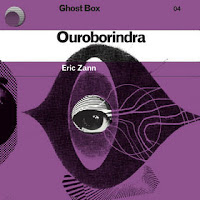 My favourite of their albums is Ouroborindra (2005) by Jim Jupp under his Eric Zann moniker, itself a horror reference to H.P. Lovecraft that somewhat sets the tone - this is a dark, off-kilter album. Hammer horror films form the crux of the album's reference points, and the weird voices and soundtrack samples highlight just how creepy and disturbing the best Hammers were, although much credit has to go to Jupp for highlighting this. Alongside weird sound effects of blowing winds and cawing crows, he creates 5 unsettling tracks of wonky electronica and sophisticated pop, perhaps highlighting "hauntology"'s place not just as a new pop genre, but as an avant-garde pop genre.
Overall, the feeling when listening to the music of the Ghost Box artists, much like Oneohtrix Point Never or Emeralds or even Pocahaunted, is that you are in the presence of the specter of a future that could have happened, but ultimately didn't. It's ectoplasmic music, seeping through into our world via many of the same channels, but distant, elusive and, ultimately, troubling.
In contrast, Mordant Music's muse is all the more current than that of the Ghost Box clique. Or at least more urban, with the electronica further to the fore, and hints of disco, dub and hip hop polluting his dreamy sampled ambience. Dead Air (Mordant), from 2006, shared a twinge of nostalgia and a taste for layered samples and crackly ghost voices with Ghost Box, but, alongside the Public Service Annoucements and excerpts of disembodied TV voices, also laid down pounding beats and hypnotic grooves, effectively bridging the gaps between Ghost Box and Oneohtrix Point Never; and Ghost Box and retro-technoists like Lindstromm. SyMptoMs (Mordant), from 2009, even added live vocals by Mordant's Ian Hicks, making it something of a cousin to Broadcast's electro-psych (fitting, seeing as the Birmingham duo recorded an EP with The Focus Group last year, to much acclaim), and showing "hauntology"'s ability to take on ghosts of the more recent past like r'n'b and pop songs.
 In this respect, MM can also claim an affinity (again, like Broadcast) with dubstep's mysterious standard bearer Burial. Burial is very different to most of the dubstep artists currently taking London's club scene by storm. A wealth of twenty-something dubstep and wonky/funky producers, such as Kuedo, Joker, Joy Orbison and Ikonika have mined their 80s childhoods for sounds and references that will also be mirrored in the experiences of their audience, from video games (i.e. Kuedo's excellent "Starfox", named after the Nintendo game) to vintage movies (check out Joker's new "Tron" single).
But Burial is different. For a start, his music is definitely not there just as a way of getting people on the dance floor. It's not that danceable, really. The tracks on both his seminal debut Burial (Hyperdub, 2006) and its exquisite follow-up Untrue (Hyperdub, 2007) use samples and effects lifted from films and pop songs, as well as crackling vinyl static and hazy ambience, much like other "steppas", but these sounds are distorted and manipulated, until voices become unrecognisable, shifting between picthes and even genders (good luck spotting the Christina Aguilera sample on "Archangel"!) and familiar sounds appear far away and alien. With its strong urban vibe, the music of Burial comes across as a nocturnal drive through an indistinguishable city as the ghosts and spirits of its long-gone inhabitants melt fleetingly into reality through the radio and windows. This conveys a supreme sense of melancholy to Burial's music, taking it above and beyond the best of his peers, even Kode 9.
 Coming full circle, it would be a big mistake to sign off a piece on memories and ghosts in music without writing about James Kirby, aka Leyland Kirby, aka The Caretaker (and several other pseudonyms beyond those two). Kirby was born in Stockport in the mid-seventies and developped a fascination for ancient vinyl-edition songs from the 1920s and horror movies. His The Caretaker moniker is a direct reference to Stephen King's seminal The Shining, in which Jack Torrance (famously played by another Jack, Nicholson, in the film adaptation) is hired to be the caretaker of a old mountain-top hotel, only to find himself possessed by the unquiet spirits of deceased guests. Condemned to be the ghostly caretaker for eternity, Torrance is the perfect mirror reflection for Kirby, the latter's music, built from his collection of scratchy 1920s vinyls, which he loops and manipulates into hypnotic dark ambient pieces, seeming to be less actual songs than the echoes through time of a long-ended cocktail party. This approach is similar to that of avant-garde composer Philip Jeck, whose superb Stoke (Touch Records, 2002) and Sand (Touch Records, 2008) albums used old vinyl records to create wildily evocative and sophisticated compositions (Jeck's music is too sophisticated to be best served here, though "Pax" on Stoke is a perfect piece of proto-Caretaker hauntology and a benchmark of memory music). Revenant music by any measure of the term, The Caretaker is best approached on his most recent LP, Persistent Repition of Phrases (History Always Favours The Winners, 2008), in which snatches of music hall tunes, distant orchestras and fading piano and string melodies drift around your senses like a lonely breeze.
But he took things to a particular height on Sadly The Future Is No Longer What It Was (History Always Favours the Winners, 2009), a titanic 3-disk magnum opus recorded under the name Leyland Kirby, one that references both past (it was his grandfather's name) and present (Leyland is his second name), and a guise that allows him to take the best of The Caretaker's universe, and strip it down to its most harrowing bones. There's an absence of sampled voices or strings or melodies, the only non-Kirby sounds on here apparently being ambient noises like klaxons, rain, traffic or wind, by-products perhaps of the recording space, something that therefore evokes Basinski's 92982 (see how we come full circle). As with Basinski or Eno, the music here is sparse, either looped piano chords or delicate waves of mournful synth or dissonant grey noise, and the feeling you get is that this is the artist alone, still, as with The Caretaker, staring into the inner memories of the past, but unwilling this time to try and conjure them back. The ghosts are fading, the future is bleak, no longer the Brave New World vision of old, and the man is alone. It's a harrowing, exhausting listen, but there is no doubt that Sadly The Future Is No Longer What It Was is a stupendous achievement.

In the US, this is called "hypnagogic pop", referring to the transitional moment between sleep and wakefulness. It's quite a good term for acts like Oneohtrix Point Never, Pocahaunted and Emeralds, whose music rests in a strange Twilight Zone between most of the musicians' background in garage and noise, their almost-musicological embracing of 60s and 70s pop and rock, and the inspiration of once-obsolete eighties psychedelic, the kind that gave us tripped-out rock bands such as Psychic TV, Echo & The Bunnymen and Dream Syndicate, but also Kate Bush, Tom Tom Club, latter-period Talk Talk and full sensory assault movies like Predator, Aliens, Evil Dead, Top Gun and Blade Runner.

Pocahaunted
Also worth listening to is Grouper, the moniker of another former noise-er, Liz Harris who now lays her dreamy, reverb-drenched vocals over delicate folk arpeggios and wisps of listing ambience. Again, a background in subtly-shifting noise gives Harris a distinctive knack for creating dense atmospheres and murkily psychedelic undercurrents that seem to come at you from somewhere far away in both space and time. The result is truly spectral, with the phantoms of souls long gone being channeled particularly effectively on 2008's wonderful Dragging a Dead Deer Up a Hill (Type Records).

In the UK, things are typically more "concrete" and thought-through, with our answer to America's "hypnagogic" spectral music being given the name "hauntology" by Wire journalist Simon Reynolds, who also coined the term "post-rock" (so quite prolific in the genre-naming field), in reference to a theory by Jacques Derrida wherein humanity at the end of history would "begin to orient itself towards ideas and aesthetics that are thought of as rustic, bizarre or "old-timey", in other words the specter of its common history.
I'm not sure all musical "hauntologists" are familiar with Derrida, but it is undeniable that these artists are following a similar philosophy with regards to their music. The massive progress in technology means music can be conjured from nowhere using computers and sequencers, we are in the midst of ultimate musical futurism, but these artists find more inspiration when using this technology from decades long since revolved, even since before the artists themselves were born! It that respect, I am reminded of the films of Tarantino, which cross-reference decades of movie under-culture, a testament to his years as a voracious consumer of VHS, the first format to immortalise film art in a format accesible to all, as vinyl did for music. They have since been replaced by DVDs, CDs, mpegs and the internet, veritable treasure troves of art and culture once deemed lost, all at arm's reach for current generations of musicians and creatives.
 At the centre of the musical "hauntology" scene is the Ghost Box label, the brain child of two musical mavericks, Julian House and Jim Jupp (left), who contribute about 90% of the label's output under a variety of monikers: The Focus Group (House), Belbury Poly, Eric Zann (Jupp). I will admit to finding a lot of their works hard to get into, mainly because they are mostly made up of very short tracks (around 90 seconds to 2 minutes per track), something I often find difficult. But there is no denying the clarity of the label's vision, both musical and artistic (each record is housed in an immediately identifiable sleeve, with consistent artwork and liner notes). The world of Ghost Box is pure "hauntology": their kitchen-sink approach takes in a wealth of reference points from 5 decades of British pop culture: Hammer horror films, psychedelic music, Tomorrow's World, Dr Who, industry strikes, radio shows and early morning TV. It's a beguiling mixture, strongest on Belbury Poly's The Owl's Map (which includes a guide to the Hammer-esque fictional town of Belbury), The Focus Group's We Are All Pan's People and The Advisory Circles's Other Channels. The music, touched by The Kinks (in their Are The Village Green Preservation Society mode), English folk, early electronica such as that of Delia Derbyshire and The BBC Radiophonic Workshop, advertising jingles and modern styles like trance or noise, is equal parts wistful nostalgia (The Wire mention things like public service announcements and the Open University) and unsettling disquiet. Strange voices emerge from crackling radio static, retro synths battle for space among pounding percussion and hip-hop breaks, and at all times you're left wondering what's going on and where you stand.
Overall, the feeling when listening to the music of the Ghost Box artists, much like Oneohtrix Point Never or Emeralds or even Pocahaunted, is that you are in the presence of the specter of a future that could have happened, but ultimately didn't. It's ectoplasmic music, seeping through into our world via many of the same channels, but distant, elusive and, ultimately, troubling.
In contrast, Mordant Music's muse is all the more current than that of the Ghost Box clique. Or at least more urban, with the electronica further to the fore, and hints of disco, dub and hip hop polluting his dreamy sampled ambience. Dead Air (Mordant), from 2006, shared a twinge of nostalgia and a taste for layered samples and crackly ghost voices with Ghost Box, but, alongside the Public Service Annoucements and excerpts of disembodied TV voices, also laid down pounding beats and hypnotic grooves, effectively bridging the gaps between Ghost Box and Oneohtrix Point Never; and Ghost Box and retro-technoists like Lindstromm. SyMptoMs (Mordant), from 2009, even added live vocals by Mordant's Ian Hicks, making it something of a cousin to Broadcast's electro-psych (fitting, seeing as the Birmingham duo recorded an EP with The Focus Group last year, to much acclaim), and showing "hauntology"'s ability to take on ghosts of the more recent past like r'n'b and pop songs.
 In this respect, MM can also claim an affinity (again, like Broadcast) with dubstep's mysterious standard bearer Burial. Burial is very different to most of the dubstep artists currently taking London's club scene by storm. A wealth of twenty-something dubstep and wonky/funky producers, such as Kuedo, Joker, Joy Orbison and Ikonika have mined their 80s childhoods for sounds and references that will also be mirrored in the experiences of their audience, from video games (i.e. Kuedo's excellent "Starfox", named after the Nintendo game) to vintage movies (check out Joker's new "Tron" single).
 But Burial is different. For a start, his music is definitely not there just as a way of getting people on the dance floor. It's not that danceable, really. The tracks on both his seminal debut Burial (Hyperdub, 2006) and its exquisite follow-up Untrue (Hyperdub, 2007) use samples and effects lifted from films and pop songs, as well as crackling vinyl static and hazy ambience, much like other "steppas", but these sounds are distorted and manipulated, until voices become unrecognisable, shifting between picthes and even genders (good luck spotting the Christina Aguilera sample on "Archangel"!) and familiar sounds appear far away and alien. With its strong urban vibe, the music of Burial comes across as a nocturnal drive through an indistinguishable city as the ghosts and spirits of its long-gone inhabitants melt fleetingly into reality through the radio and windows. This conveys a supreme sense of melancholy to Burial's music, taking it above and beyond the best of his peers, even Kode 9.
 Coming full circle, it would be a big mistake to sign off a piece on memories and ghosts in music without writing about James Kirby, aka Leyland Kirby, aka The Caretaker (and several other pseudonyms beyond those two). Kirby was born in Stockport in the mid-seventies and developped a fascination for ancient vinyl-edition songs from the 1920s and horror movies. His The Caretaker moniker is a direct reference to Stephen King's seminal The Shining, in which Jack Torrance (famously played by another Jack, Nicholson, in the film adaptation) is hired to be the caretaker of a old mountain-top hotel, only to find himself possessed by the unquiet spirits of deceased guests. Condemned to be the ghostly caretaker for eternity, Torrance is the perfect mirror reflection for Kirby, the latter's music, built from his collection of scratchy 1920s vinyls, which he loops and manipulates into hypnotic dark ambient pieces, seeming to be less actual songs than the echoes through time of a long-ended cocktail party. This approach is similar to that of avant-garde composer Philip Jeck, whose superb Stoke (Touch Records, 2002) and Sand (Touch Records, 2008) albums used old vinyl records to create wildily evocative and sophisticated compositions (Jeck's music is too sophisticated to be best served here, though "Pax" on Stoke is a perfect piece of proto-Caretaker hauntology and a benchmark of memory music). Revenant music by any measure of the term, The Caretaker is best approached on his most recent LP, Persistent Repition of Phrases (History Always Favours The Winners, 2008), in which snatches of music hall tunes, distant orchestras and fading piano and string melodies drift around your senses like a lonely breeze.
But he took things to a particular height on Sadly The Future Is No Longer What It Was (History Always Favours the Winners, 2009), a titanic 3-disk magnum opus recorded under the name Leyland Kirby, one that references both past (it was his grandfather's name) and present (Leyland is his second name), and a guise that allows him to take the best of The Caretaker's universe, and strip it down to its most harrowing bones. There's an absence of sampled voices or strings or melodies, the only non-Kirby sounds on here apparently being ambient noises like klaxons, rain, traffic or wind, by-products perhaps of the recording space, something that therefore evokes Basinski's 92982 (see how we come full circle). As with Basinski or Eno, the music here is sparse, either looped piano chords or delicate waves of mournful synth or dissonant grey noise, and the feeling you get is that this is the artist alone, still, as with The Caretaker, staring into the inner memories of the past, but unwilling this time to try and conjure them back. The ghosts are fading, the future is bleak, no longer the Brave New World vision of old, and the man is alone. It's a harrowing, exhausting listen, but there is no doubt that Sadly The Future Is No Longer What It Was is a stupendous achievement.

Sadly The Future Is No Longer What It Was by Leyland Kirby
Memory, elusive and deceptive, will always be a favoured domain of musical exploration for singers, musicians and performers of all genres. But, from Ghost Box's hauntologists to drone and ambient masters like Eno, Basinski and LaMonte Young, via the new "hypnagogic pop" of America and Burial's ghostly take on modern dance, there are some disparate artists who are intelligently going beyond the base retro nostalgia that has given us the current wave of uber-trendy NME bands (I'm looking at you, Libertines, Killers, Bloc Party, The Strokes and, blech, Kasabian) and so many endless money-grabbing reunions, to delve into music that is challenging, ecelctic and unpredictable. Ghosts of the past, both individual and collective, seep out of CDs and vinyl and mp3s, making the memories -grasped at, missed, held for a few heart-rending seconds- the centrepiece of the sound, rather than just a tool to gain indy cred. It's an emotionally draining experience to listen to some of this music, as hard to get your head around as that dream you had last night that is already fading, or that long-gone event that impacted your life, however briefly. There are so many phantoms out there, imagined, remembered, forgotten or real. Time to bring them into the musical light.


